
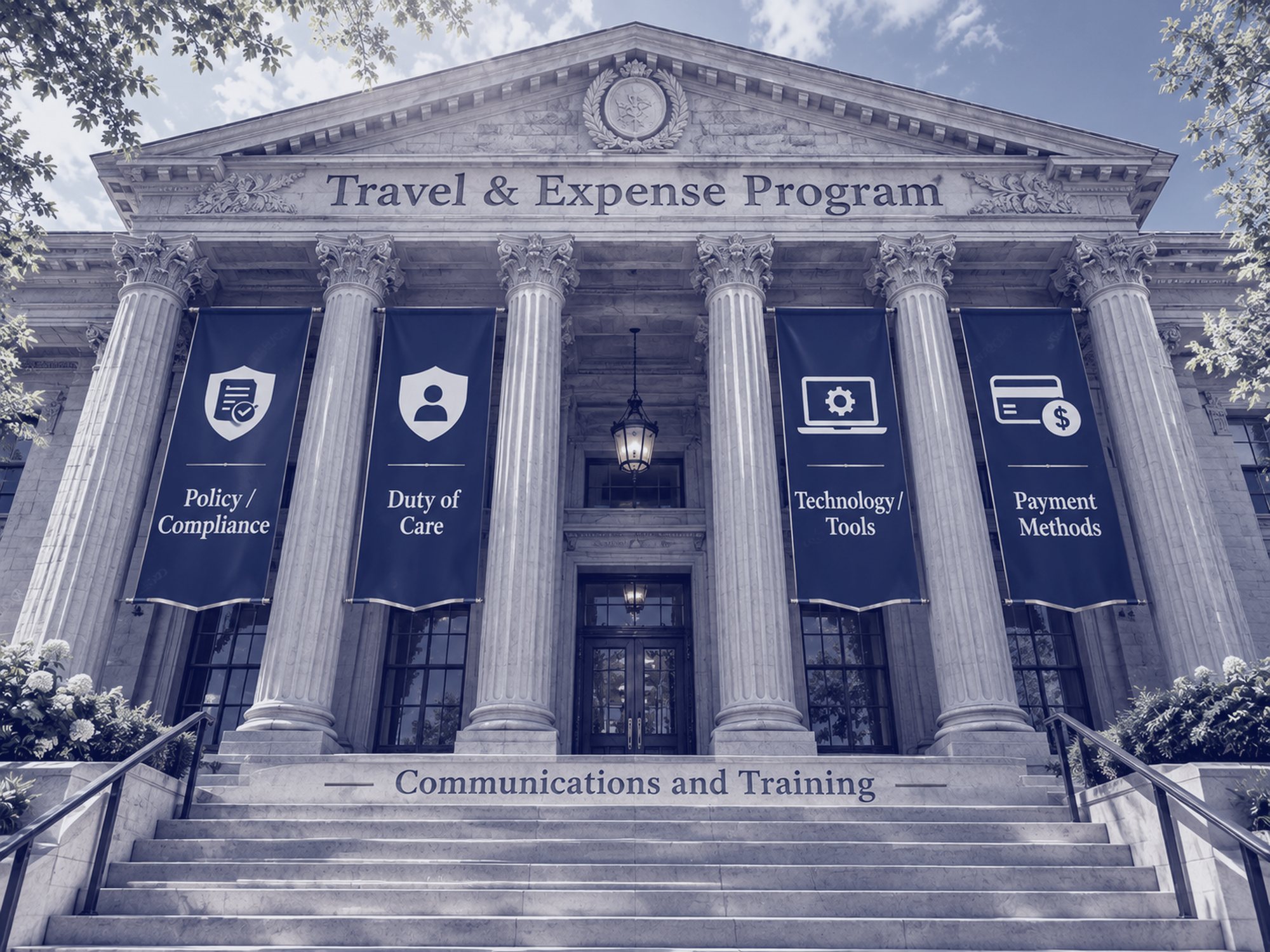
Four pillars, one foundation. Take away the stairs and nobody gets in the building.
The email lands on a Tuesday. Subject line: "Draft findings, FY26 internal audit." You scroll. Missing receipts. A business meal with no attendees listed. Airfare bought on a personal card eleven weeks before anyone asked whether the trip was approved. By the last page, close to half the exceptions trace back to travel and expense (T&E), a category that is a sliver of the budget.
T&E is typically 5 to 10 percent of spend. Before a good program exists, it can be up to half of your audit exceptions.
That ratio is why T&E deserves a real program. In the higher ed programs I’ve assessed, T&E runs 5 to 10 percent of institutional spend, yet it can drive up to 50 percent of internal and external audit exceptions, and it’s the place I most often see fraud take root. It’s thousands of small transactions, made far from the finance office by people who would rather be teaching. The Association of Certified Fraud Examiners’ Occupational Fraud 2024: A Report to the Nations (March 2024) found that expense reimbursement schemes typically ran 18 months before anyone caught them.
The problem underneath isn’t the software
Most campuses answer that audit report by shopping for a tool. A tool is one pillar. A T&E program stands on four: policy and compliance, duty of care, technology and tools, and payment methods. All four stand on a staircase of communications and training, which is what change management really is. Buy one pillar and you own a very expensive column in a field.
Here’s what makes higher ed different. We don’t get compliance with institutional policy, state and federal rules, or NCAA regulations by mandate. Faculty in particular can’t be managed that way. We get it by making the compliant path the easy one and by showing each traveler what they gain. So every pillar has to answer a selfish question.
Policy and compliance: can I find the rule, in plain language, in under a minute?
Duty of care: if something goes wrong in Lisbon, does anyone know I’m there? This was once the optional pillar. With students and faculty abroad, it has been far less optional since COVID.
Payment methods: do I have to float the university $2,400 on my own Visa? A travel card, a lodge card held at your travel management company (TMC) for airfare, and declining balance cards for student travel take personal money out of the picture. The card feed pre-fills the expense report, and the rebate helps pay for the program.
Technology and tools: can I book and expense from my phone? IDC MarketScape’s 2025 assessments of AI-enabled T&E applications (August 2025) named SAP Concur a Leader in all four of its reports, the only vendor to manage that, and Emburse a Leader in three. Navan, rated 4.4 stars by Gartner Peer Insights reviewers (2026), is the third name you’ll hear most, though rarely on a campus. On campuses I see SAP Concur, Emburse, the Workday expense and procurement card modules, and Oracle Cloud expense. The ERP modules come at no added license cost and don’t need integrations built on day one. The purpose-built tools do more: booking tied to your TMC, mobile receipt capture that actually works, enhanced card feeds, e-receipt imports, and robust audit rules and policy training “in tool”. Cost, functionality and ease of use all count, and the right answer depends on your volume, your cards, your people and your organizational culture.
Run the four-pillar test this week
Four things you can do before Friday without hiring anyone. Pull last year’s audit findings and tag each one to a pillar; the biggest pile tells you where to start. Ask what share of airfare was booked through your TMC. That number is your duty of care coverage, because you can’t help a traveler you can’t find or do not know is traveling. Pull the share of T&E dollars that ran on a university card versus personal reimbursement. Then hand your travel policy to a new hire, ask what the receipt threshold is, and time them.
What good looks like is "much better"
My favorite training clip (and I may be aging myself here) is from Seinfeld ("The Alternate Side," NBC, December 4, 1991, written by Larry David and Bill Masters). Jerry stands at a rental counter holding a reservation for a car that has been given away. In a well-built program that scene lasts ninety seconds: he opens the mobile app, or calls a TMC agent, and has another car. Humor works in training because nobody retains a 40-slide policy deck, and because it’s honest. Travel for work isn’t always fun, and no one likes doing an expense report.
Fully integrated looks like this. The trip is requested in advance (when required by your institution or state), the trip is booked in adherence to your policies, with your discounts applied. The itinerary is visible to the people responsible for traveler safety. The card charge and the e-receipts post into the expense report within a couple of days, all on their own. The report is mostly built before the traveler gets home, moves through approval without detours, and posts to the ERP without anyone re-keying it. Reporting is accurate and tells the institution, and each department within it, what it needs to know to make good decisions. Training shows up just in time, tied to the stage of the trip, instead of once a year in an auditorium.
The back office is getting easier too. At the 2026 SCTEM conference session "Autopilot Engaged: Real-World AI in Travel Programs," which I coordinated, the University of South Florida described a policy chatbot build whose generative upgrade improved answer-finding by an estimated 30 to 40 percent, along with the lesson that an accurate answer isn’t always a clear one. They have also enabled custom reporting in Microsoft Excel Copilot, sourced from Power BI data, which gives administrators, leaders and financial managers fast access to the information they actually use. The University of Michigan showed a 24/7 automated policy assistant for all Procurement that hands off to a person when judgment is needed. Georgia Tech reported 15 automations deployed in two years, worth more than $800,000 in staff time, including bots that chase past-due (aging) PCard verifications. Every one of them depends on current policy and a clean process underneath. AI is a new aspect of the technology and tools pillar that is moving at a rapid pace.
I tell clients we’ve succeeded when people say the process is "much better." Every now and again someone says "it’s a great change." More often we’ve simply taken pain and time out of an obnoxious chore, and next year’s audit report is shorter.
That’s the work I do at Clay Downs for colleges and universities: assessing current programs, refining the ones that mostly work, implementing new ones, comparing technology, tools and payment options, and writing policy that is straightforward enough for people to follow.
Sources
Association of Certified Fraud Examiners. Occupational Fraud 2024: A Report to the Nations. March 2024. acfe.com/RTTN
IDC. IDC MarketScape: Worldwide AI-Enabled Travel and Expense Applications 2025 Vendor Assessments (Enterprise, Midmarket, Small Business). August 2025. As reported by SAP Concur, "AI-Driven Solutions: Why SAP Concur Is a Four-Time Leader in IDC MarketScape T&E Software 2025," October 20, 2025, and Emburse, "Emburse Named a Leader in Three 2025 IDC MarketScape Reports," Business Wire, August 14, 2025.
Gartner Peer Insights. "Emburse vs Navan," Expense Management Software market. Accessed September 2026. gartner.com/reviews
Araujo, S., Harp, D. (University of Michigan), Zeljo, S. (University of South Florida), and Jamison, L. (Georgia Tech). "Autopilot Engaged: Real-World AI in Travel Programs." SCTEM Annual Conference, 2026.
Seinfeld. "The Alternate Side." Season 3. Written by Larry David and Bill Masters. NBC, December 4, 1991.
Spend share, audit exception and fraud observations are the author’s, drawn from 90+ higher education T&E engagements.
About the author. Elizabeth Downs is Founder & Principal of Clay Downs Consulting, a travel and expense consulting firm built exclusively for higher education. She has led 65+ T&E implementations across 85+ colleges, universities and academic medical centers. More about Elizabeth · LinkedIn